One system runs the whole institution.
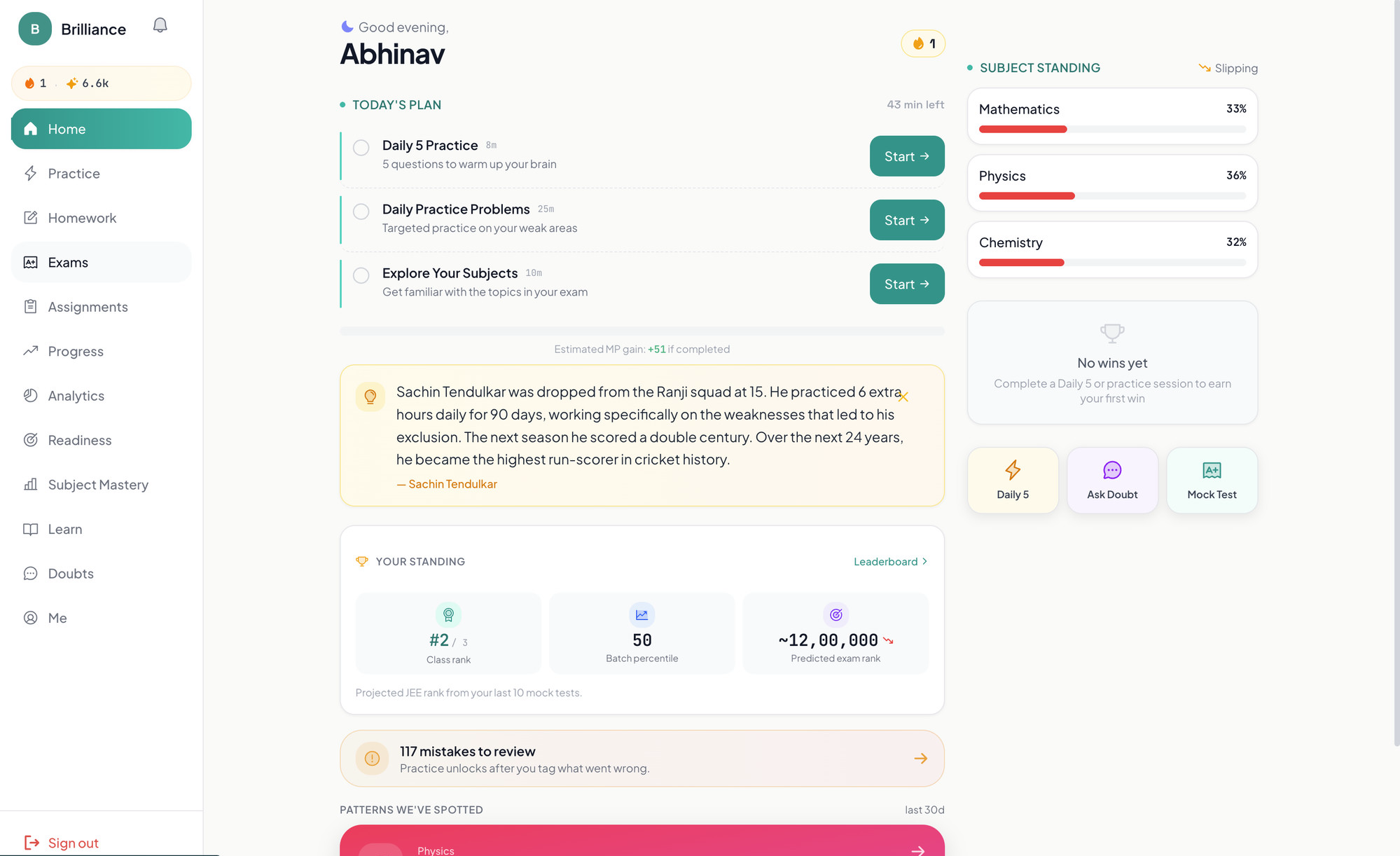
Brilliance replaces the ERP, LMS, question bank, proctor, analytics, SMS, parent app and doubt chat a junior college stitches together — with one system, tailored boutique to each institution's ethos and workflow before go-live. Four surfaces share one brain: a leadership/faculty dashboard, a student app, a parent app, and an ops console. 350+ screens, 11 AI features live, every Intermediate stream (MPC, BiPC, MEC, CEC) on one engine.
A 5.5-million-student, ₹60,000-crore coaching industry still runs on pen, paper and WhatsApp — an ERP that can't talk to the LMS, a question bank that can't talk to a proctor, analytics no parent can read. Every institution teaches differently, yet every vendor ships the same rigid product.
A single live 0–100 score under every screen. ERI condenses 500,000+ signals per student — every exam, mock, assignment and doubt — into a time-decayed readiness measure. The atomic unit is the cell (subtopic × question-type × difficulty × Bloom's level), ~250 per exam, created lazily; a 21-day half-life models forgetting. It doesn't give a grade — it gives a prescription: 'work these five subtopics, in this order, for the most marks per hour.'
Every question is generated, scored and rewritten before faculty see it: Stage 1 maps 21 cognitive operations across 4 difficulty bands; Stage 2 scores it on five axes (cognitive load, trap quality, answer defensibility, clarity, exam-pattern fidelity) with Claude Haiku 4.5; Stage 3 rewrites any flagged axis with Claude Sonnet 4.6. Vision-first extraction turns any PYQ PDF, DOCX or scan into a structured bank; OMR auto-grades answer sheets. Everything lands in review — faculty approve; the AI just removes the typing.
Four surfaces on one multi-tenant codebase: leadership analytics (cross-branch cohorts, bell curves, at-risk lists, faculty-impact, syllabus coverage), a faculty console (AI question generation, vision extraction, secure exams, OMR, grading, live classes), an ops console (attendance, fees, admissions, PTM), and student + parent apps with a multilingual agentic faculty that answers doubts by text, voice or photo and prescribes practice from the student's own ERI graph. Every deployment is white-glove configured to the institution's brand, workflow and chain of command.
 React
React Next.js
 Node.js
 PostgreSQL
 ClaudeVision AIMulti-tenantAWS
Tell us what you’re building.
Send the brief, the deadline, and the constraint the last quote couldn't meet. In one call you'll get a straight read on what we'd build, across which surfaces, and how fast.
We reply within one working day.